


| Infobox: Solar Symbolism | |
|---|---|
| Field: | History of Religions / Anthropology |
| Prominent Deities: | Ra, Shamash, Utu, Mithra |
| Associated Symbols: | Solar cross, circle, winged disk |
| Current Religions: | Yazidism, Mandaeism, Christianity symbolically |
The Symbolism of the Sun in Ancient and Contemporary Beliefs: A Historical and Theological Study
Anthropological readings and the history of religions reveal a remarkable continuity of certain deeply ancient beliefs. Despite civilizational transformations, ancient religions such as Yazidism and Mandaeism have maintained their continuity and renewed their rituals into the modern era. Within the development of human religious thought, humanity moved from divine plurality toward the veneration of major cosmic phenomena, foremost among them the symbolism of the sun and the moon, as visible manifestations representing forces of pure goodness.
Mythological Roots: The Celestial Trinity and the Emergence of Light
Ancient mythology points to the concept of a “celestial trinity” composed of the moon, the sun, and Venus. In this system, the moon represents the “father,” the sun the “mother,” and Venus the “son.”
The priority of lunar fatherhood is based on an ancient philosophical conception that darkness was the original state prevailing in the universe, and from its womb light emerged. For this reason, the moon was regarded as the father of the sun, which represents its greatest radiance and its major manifestations in ancient beliefs.
The Solar Calendar and Major Festive Intersections
The cycle of the sun has been associated with many religious festivals and rituals throughout history. The sun reaches its lowest point in the Northern Hemisphere before December 22, then returns to appear at its peak on December 25.
- Birthday of the Sun: It formed the historical basis for the birth celebrations of Jesus Christ and Ezida.
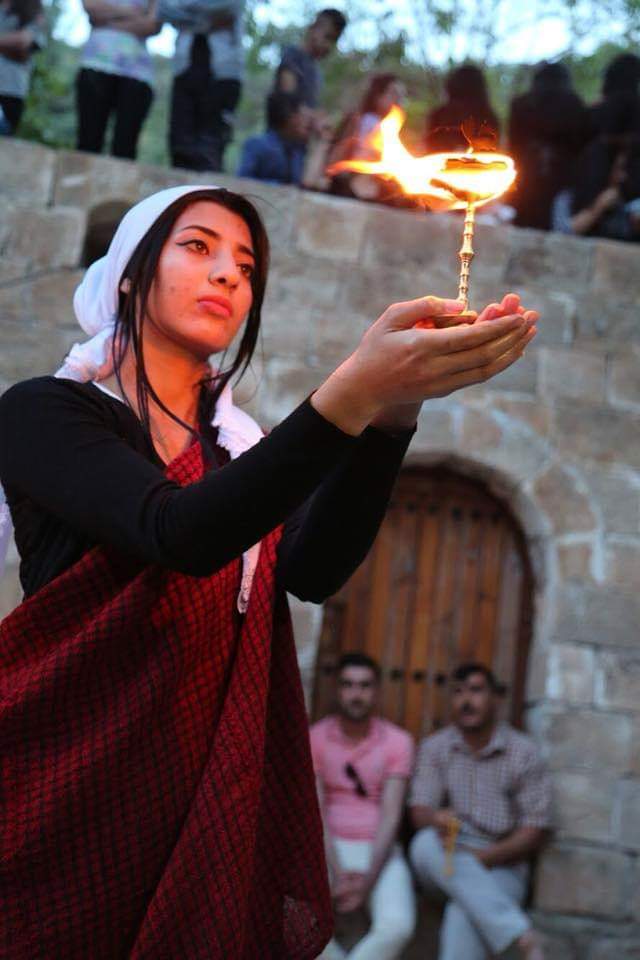
- Belinda Festival: It represents the rebirth of the sun among Yazidis, during which fires are lit and sweets are distributed.
- Civilizational Similarities: These rituals intersect with the celebrations of the Copts of Egypt and ancient festivals of light.
The Geographical Spread of Solar Veneration in Civilizations
Solar symbolism spread across various regions of the ancient world and appeared in diverse theological forms:
| Civilization / Religion | Name or Manifestation | Theological Significance |
|---|---|---|
| Mesopotamia | Utu / Shamash | God of justice and truth |
| Ancient Egypt | Ra / Amun | Creator of life and source of power |
| Christianity | Direction of the East / Sunday | Symbolism of Christ’s resurrection and the Light of the World |
| Mithraism | Mithra | The unconquered sun |
The Doctrinal Specificity of the Sun in Yazidism
In Yazidi theology, the sun is not worshipped as a physical entity, but is venerated as the “light of the heavens and the earth.” The sun is taken as a direction of prayer in the morning and evening, in symbolic orientation toward Paradise, which is believed to lie in the east.
Despite the importance of the Lalish Temple, turning toward the sun remains an expression of turning toward the absolute face of God. Researchers indicate that this veneration reflects the depth of ancient Mesopotamian and Mithraic influences that emphasized heavenly light.
Linguistic Semiotics and Geometric Symbols
The visual symbols expressing the sun in ancient arts were numerous:
- The solar cross (+): An innate symbol of life and fertility, found since the fifth millennium BCE at the site of Arpachiyah.
- The circle: Represents geometric perfection and infinity.
- The serrated saw-like motif: A symbol appearing in Yazidi architecture in the courtyard of Lalish, referring to the rays of the sun.
The Cosmic and Physiological Dimension of the Sun
From the perspective of modern science, the sun constitutes 99% of the mass of the solar system. Its absence would mean the dominance of “entropy” and the complete cessation of life. This scientific reality reinforces the ancient human intuition that saw the sun as the fundamental engine of existence and a vital necessity for physiological and chemical formation.
Conclusion
Across the ages, the sun remains the greatest symbol of life and divine renewal. The close connection between cosmic light and the divine absolute confirms the view that the universe was created to serve humanity, enabling humans to perceive through it the greatness of their Creator.
References
- Al-Sawwāḥ, Firas. (1994). The Religion of Man: A Study of the Essence of Religion and the Origin of the Religious Impulse. Dar Alaa al-Din.
- Ali, Jawad. (2001). Al-Mufassal fi Tarikh al-Arab Qabl al-Islam / The Detailed History of the Arabs before Islam, Vol. 6. Dar al-Saqi.
- Frazer, James George. (1990). The Golden Bough: A Study in Magic and Religion. Dar al-Tali‘a.
- Habib, George. (1996). Yazidism: Remnants of an Ancient Religion. Dar Petra.
- Al-Majidi, Khazal. (1998). Incense of the Gods: A Study of Ancient Rituals and Worship. Al-Ahliyya Publishing.
- Jindy, Khalil. (1998). Towards Knowing the Truth of the Yazidi Religion. Dar al-Rashid.