

Kor Bmbark Shrine and Valley in Mount Sinjar: Historical and Religious Significance
| Official Name | Kor Bmbark Shrine and Valley (Kli Kor Bmbark) |
|---|---|
| Geographical Location | Northeastern side of Mount Sinjar |
| Religious Affiliation | Yazidi Religion |
| Spiritual Figure | Saint Sharaf al-Din |
| Custodianship and Administration | Babiri Family (descendants of Ismail Salih Agha) – al-Mutarbiya Tribe |
| Main Landmarks | Qola Kor Caves, Treasury of Sharaf al-Din, Treasury of the Sacred Cloak, Bakra Tribe Cemetery |
Mount Sinjar represents the historical and spiritual stronghold of the followers of the Yazidi religion, where rugged geography intertwines with religious sanctity to form a safe refuge throughout history. Among the most important landmarks embodying this complex relationship is the Kor Bmbark Shrine and Valley, which stands as one of the region’s most prominent sacred sites. This article sheds light on the geographical, religious, and social significance of the location, relying on topographical data and oral traditions preserved within collective memory.
The Geographical and Environmental Context of Kor Bmbark Shrine and Valley
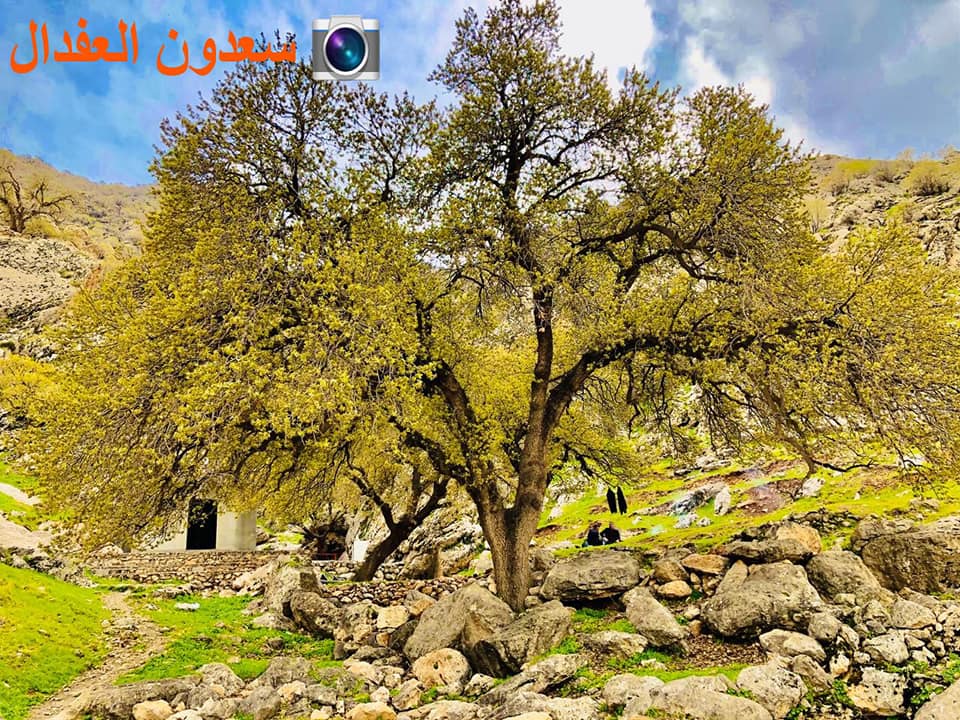
The valley occupies a strategic and vital position on the northeastern side of Mount Sinjar. It is bordered by the village of “Osfa” to the west and the village of “Bakra” to the east. The valley is distinguished by unique topographical and environmental features that historically contributed to the protection of its inhabitants.
Geological Formation and Natural Shelters
The valley contains a complex network of deep and fortified caves. The “Qola Kor” caves are among the most famous locally, notable for their vast capacity to shelter thousands of people. Due to the difficulty of accessing them except through rugged and narrow paths, the geography played a significant defensive role, providing safe havens for local communities during invasions and historical genocidal campaigns.
Biodiversity and Vegetation Cover
The valley enjoys high fertility and remarkable biodiversity. The site is rich in dense tree cover, including various fruit-bearing trees alongside forest species characteristic of the mountain environment. Among its most notable trees are:
- Fig, apple, and grape trees.
- Dense oak forests.
- A variety of mountain plants known for medicinal properties.
Religious and Spiritual Importance in Yazidi Consciousness
The Kor Bmbark Shrine and Valley possess exceptional sanctity rooted in profound historical and spiritual foundations within Yazidi heritage.
Historical Connection to Saint “Sharaf al-Din”
Oral traditions affirm that this valley served as a settlement and refuge for Saint “Sharaf al-Din” and his followers approximately eight centuries ago before they moved toward western regions. As a result, the valley is regarded as an authentic spiritual extension of his shrine located in the village of “al-Rashid,” granting the site a deep aura of holiness and reverence.
Ritual Treasuries and Sacred Storehouses
The geographical depths of the valley contain ritual storehouses known as “Khaznat” (treasuries), reflecting the organized nature of devotional practices. The following table highlights the most prominent treasuries and their ritual significance:
| Name of Sacred Treasury | Function and Ritual Importance |
|---|---|
| Treasury of Sharaf al-Din | Dedicated to collecting vows and monetary donations offered by visitors and believers, locally referred to as (al-Dahik). |
| Treasury of the Sacred Cloak | Functions as a secure repository for preserving aged sacred religious items (such as remains of sacred cloaks and old ritual fabrics) to protect them from damage or desecration. |
Social Practices and Environmental Taboos
The religious sanctity of the valley established a strict system of customary laws and environmental taboos regulating the relationship between humans and nature, particularly concerning agricultural resources and fruit-bearing trees within the valley:
- Prohibition of Commercial Exploitation: Harvesting fruits for sale in markets or financial profit is strictly forbidden.
- Prohibition of External Transport: Visitors and residents are not permitted to take fruits outside the boundaries of the valley.
- On-site Consumption and Blessing: Fruits may only be consumed within the valley, where they are believed to be “sacred fruits” possessing healing spiritual and physical properties.
Architectural Development and Administration of Kor Bmbark Shrine
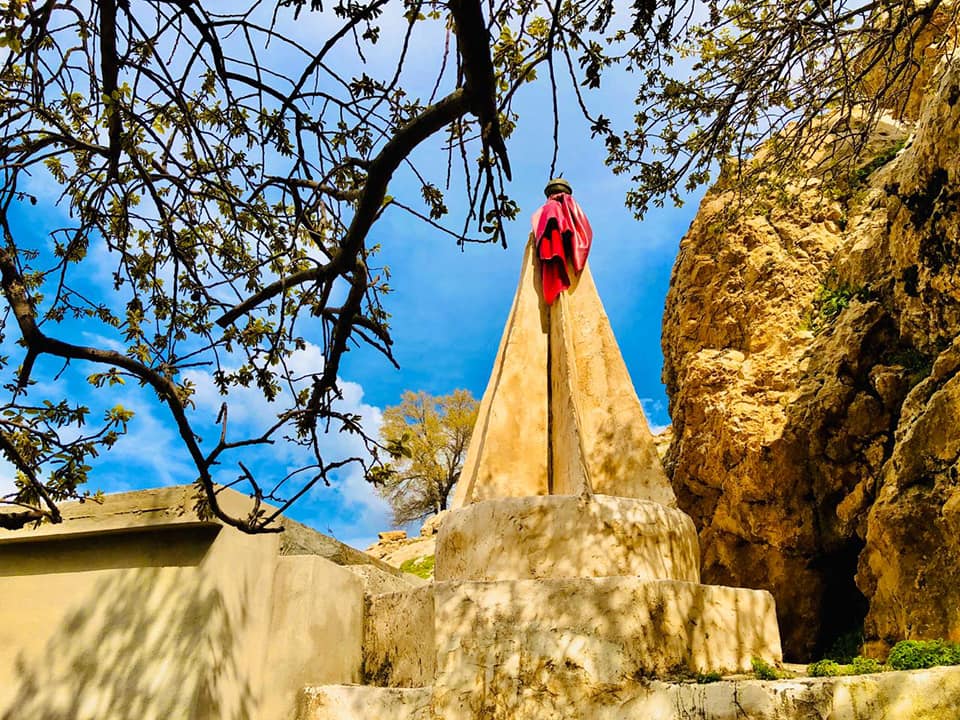
The religious monument known as the “Kor Bmbark Shrine” is located at the main entrance of the valley. This sacred structure has undergone multiple stages of architectural and administrative development.
Stages of Architectural Development
During the early period associated with the settlement of Saint “Sharaf al-Din,” the shrine consisted of a simple stone chamber built with modest geometric design. In later periods, the site witnessed notable architectural development, including the construction of a traditional Yazidi religious dome above the original structure. This expansion relied heavily on charitable donations from Yazidis, particularly contributions from members of the “Bakra” tribe.
Custodianship and Shrine Administration
The Babiri family, specifically the descendants of “Ismail Salih Agha” from the “al-Mutarbiya” tribe, are responsible for serving and maintaining the shrine, a role traditionally referred to as custodianship (Sadana). This family is regarded as the legitimate guardian entrusted with preserving the heritage of Saint Sharaf al-Din since his departure from the region.
Historic Cemetery and Associated Landmarks
The western side of the shrine contains a historic cemetery belonging to the “Bakra” tribe. The cemetery derives its importance from being the burial place of several prominent figures in Yazidi history, most notably the well-known religious and social figure “Osi Dogho.”
Conclusion
The Kor Bmbark Shrine and Valley represent a unique and integrated example of the fusion between geographical environment and religious belief in the Middle East. It served not only as a physical refuge protecting inhabitants through its fortified caves against successive threats, but also as a spiritual sanctuary and institution that preserved the identity, collective memory, and oral heritage of the Yazidi religion for hundreds of years.
References
- Açikyildiz, Birgül. (2010). The Yezidis: The History of a Community, Culture and Religion. I.B. Tauris.
- Fuccaro, Nelida. (1999). The Other Kurds: Yazidis in Colonial Iraq. I.B. Tauris.
- Guest, John S. (1993). Survival Among the Kurds: A History of the Yezidis. Routledge.
- Kreyenbroek, Philip G. (1995). Yezidism: Its Background, Observances and Textual Tradition. Edwin Mellen Press.
- Drower, E. S. (1941). Peacock Angel: Being Some Account of Votaries of a Secret Cult and Their Sanctuaries. John Murray.