


SEO Meta Data Information
- Main Keyword: Yezidi Shilk Dish
- Secondary Keywords: Yezidi folkloric cuisine, Yezidi heritage, Yezidi culture, socio-religious meanings, traditional dishes
- Suggested URL: /yezidi-folklore-kitchen-shilk-dish/
- Estimated Reading Time: 3 minutes
- Keyword Density: ~1.8%
The Socio-Cultural and Religious Dimensions in Yezidi Folkloric Cuisine: An Anthropological Study of the Yezidi Shilk Dish
The civilizational and social heritage of peoples represents an accurate mirror reflecting their historical and cultural identity. Within Yezidi society, folklore and popular heritage occupy a special place that actively contributes to preserving collective memory. “Yezidi cuisine” is considered one of the most prominent manifestations of this ancient heritage, rich with folkloric dishes rooted in deep historical traditions, for which it is difficult to find precise equivalents outside the framework of the language and Yezidi culture. This article seeks to shed light on the Yezidi Shilk dish as a cultural and anthropological phenomenon that goes beyond being merely a daily food.
This dish constitutes a central element carrying sacred meanings, social functions, and vital rituals closely linked to the environmental, economic, and living conditions of Yezidi society throughout history.
The Structural Characteristics and Preparation Methods of the Yezidi Shilk Dish
The Yezidi Shilk dish is classified among ancient traditional dishes created by the collective social mind to adapt to harsh living and economic conditions. This innovation relied on the principle of “resource economy” while fully preserving high nutritional value. The dish is distinguished by its simple ingredients, ease of preparation, and digestibility.
Methodological Preparation Steps
- Preparing the basic ingredients: The dough consists exclusively of flour, water, and salt, without the use of any yeast. The water ratio should be higher than the flour ratio to obtain a light and liquid consistency.
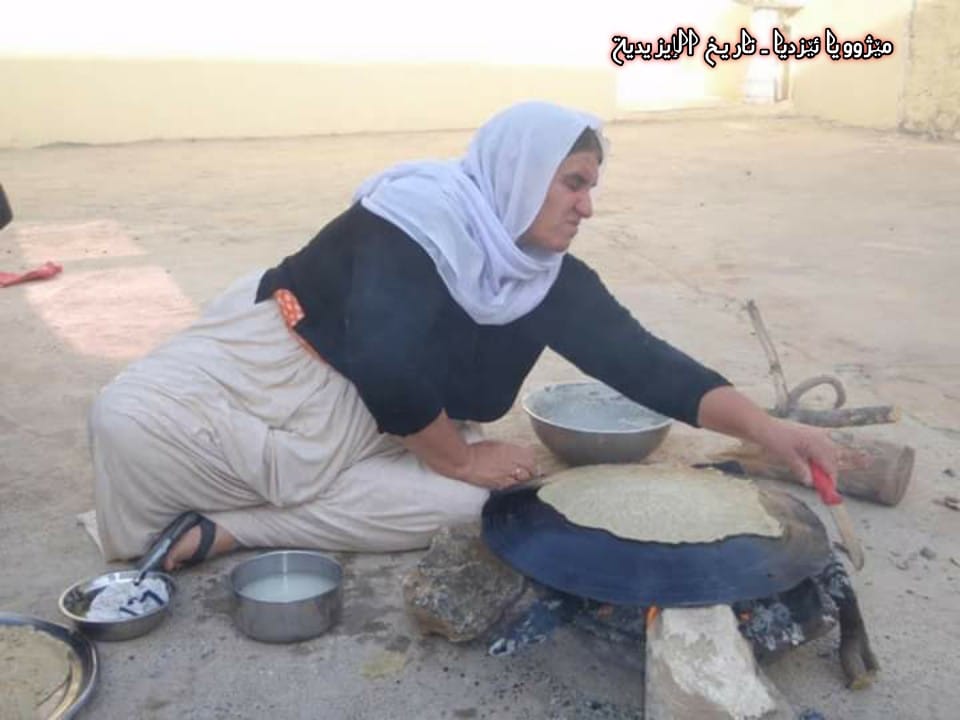
- Preparing the cooking tools: Firewood is ignited, and the metal saj (griddle) is placed over the hearth stones. To prevent the bread from burning, the underside of the saj is coated with a thin layer of dough mixed with ash, while the upper surface is greased to prevent sticking.
- The baking process: A measured amount of liquid dough is poured onto the hot saj and spread evenly. Once the first side is cooked, the bread is gently flipped to cook the other side.
- Complementary serving: After the Shilk breads are cooked, pure animal ghee (Duhni Bez) is added, and they are sweetened with honey, molasses, or sugar. They are served as a hot, energy-rich meal and are commonly consumed during spring, winter, and late autumn.
Functional Classification and Socio-Religious Meanings
The function of the Shilk dish is not limited to daily nutritional consumption; rather, it intersects with multiple temporal and spatial contexts that grant it ritualistic, protective, and healing dimensions of great importance. The following table illustrates the functional classifications of the dish according to the social and religious context within the framework of Yezidi beliefs:
| Type of Dish (Ritual Context) | Time / Place | Socio-Cultural Meaning and Function |
|---|---|---|
| “Sheikh Mishlah” Shilk | Upon returning from the Lalish Nurani Temple (during the Jema festival days). | Spiritual and commemorative function: Prepared by the lady of the house as a ritual of gratitude to God for a safe return and in honor of the memory of “Sheikh Mishlah.” |
| “Sheikh Mand” Shilk | At the beginning of May each year. | Protective function: Prepared by livestock owners and farmers for protection against snakes, in association with “Sheikh Mand” (guardian/deity of snakes). |
| “Kojrati” Shilk | During nomadic migration and tent setup (black tents). | Spatial and blessing-related function: A ritual accompanying settlement in a new location to ward off evil and bring blessings to the tribe and livestock. |
| “Postpartum” Shilk | The postpartum period (forty days after childbirth). | Healing function: Given to new mothers within traditional folk medicine practices due to its digestibility and nutritional value in restoring the body and relieving uterine pain. |
| “Belinda Bira” Shilk | On the eve of the “Belinda Bira” feast and in cemeteries. | Celebratory and funerary function: Served to farmers in the morning and taken to cemeteries as “provisions for the dead” (a historical practice that is gradually declining). |
Conclusion
The study of folkloric cuisine, through the Yezidi Shilk dish as a living example, demonstrates that food in ancient societies is not merely a biological necessity for survival, but rather an integrated symbolic system. This system documents the beliefs of society, its history, and its continuous methods of adaptation to the surrounding environment. The continuity of preparing this dish and its close association with religious and social rituals prove the resilience of Yezidi cultural identity and adherence to authenticity despite various challenges.
References
- Allison, C. (2001). The Yezidi Oral Tradition in Iraqi Kurdistan. Routledge.
- Douglas, M. (1972). Deciphering a Meal. Daedalus, 101(1), 61–81.
- Kreyenbroek, P. G. (1995). Yezidism: Its Background, Observances and Textual Tradition. Edwin Mellen Press.